Two Kinds of Debt That Derail Brand Launches — and How to Diagnose Which One You're Carrying
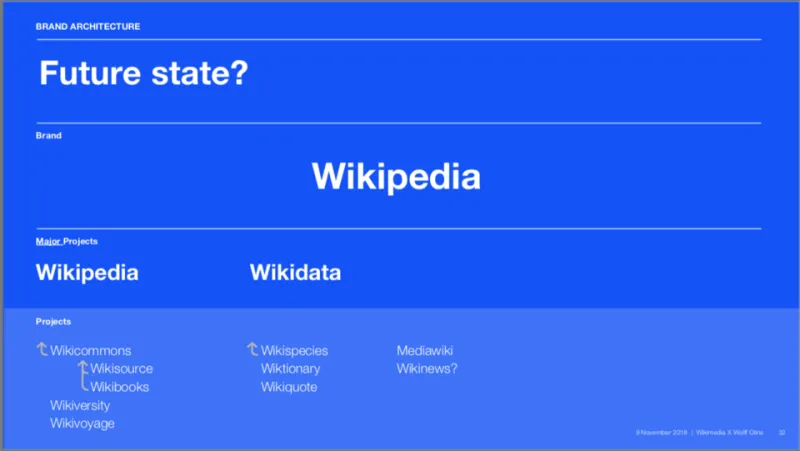
Photo: ZMcCune (WMF), CC BY-SA 4.0, via Wikimedia Commons
The software development community has spent decades building a vocabulary around technical debt — the accumulated cost of shortcuts, deferred decisions, and structural compromises that make a codebase progressively harder to maintain and extend. The concept has proven remarkably durable because it names something real: the gap between the work that was done and the work that should have been done, measured in future friction.
Brand and creative work carries an analogous burden, though the industry has been slower to name it with equivalent precision. Within any commercial brand project, two distinct categories of debt accumulate — and they are not interchangeable. Confusing one for the other is one of the most expensive mistakes a creative leader or executive sponsor can make.
Defining the Two Failure Modes
Concept debt is the liability that accrues when the foundational idea driving a brand is strategically unsound, internally contradictory, or insufficiently differentiated from competitive alternatives. It is a problem of origin — the concept was wrong, or incomplete, before execution ever began. No amount of skilled implementation resolves concept debt, because the flaw is embedded in the premise itself.
Execution debt, by contrast, accrues when a sound, well-developed concept is brought to market through implementation that fails to honor its potential. The idea is right. The delivery is insufficient. This might manifest as inconsistent visual application across brand touchpoints, messaging that lacks the precision the concept demands, or production choices that communicate a different quality level than the strategy intended.
Both types of debt produce similar surface symptoms — a brand that underperforms, fails to resonate with its intended audience, or generates internal confusion about what it actually stands for. The diagnostic challenge is that the remedies are entirely different.
Why the Distinction Matters Before Launch
Organizations that misidentify their debt type tend to invest in the wrong solution. A leadership team that interprets concept debt as an execution problem will spend significant resources refining production quality, expanding media spend, and optimizing channel strategy — all without addressing the foundational flaw. The brand may look more polished after this investment, but it will not perform differently, because the problem was never visual or operational.
Conversely, a team that interprets execution debt as a concept problem may initiate a full strategic rebrand when what was actually needed was tighter creative direction, more disciplined quality control, or more rigorous brand governance. This is a costly overreaction that discards viable strategic equity and restarts a process that did not need to be restarted.
The stakes are particularly high at the launch stage, when both types of debt are at their most consequential and when the window for efficient correction is narrowest.
Diagnostic Tools for Creative Leaders
Identifying which type of debt your project is carrying requires structured interrogation of the work at multiple levels. The following framework is designed for use by creative directors, brand strategists, and executive sponsors in the weeks preceding a major launch.
Concept Debt Indicators
- The brief cannot be summarized in a single, unambiguous sentence. If the strategic foundation requires extensive qualification to explain, the concept has not been resolved — it has been deferred.
- Internal stakeholders describe the brand differently depending on their function. Persistent internal misalignment about what the brand represents is rarely a communication problem. It is usually a signal that the concept itself contains unresolved contradictions.
- The concept cannot be distinguished from two or three competitive alternatives without referencing executional details. A concept that is only differentiated by its visual expression — not by its strategic position — is not yet a concept. It is a style.
- The creative team struggles to make consistent decisions without escalating to leadership. When execution-level choices repeatedly require senior review, it often indicates that the governing concept is not providing sufficient direction. The idea is not clear enough to be operationalized.
Execution Debt Indicators
- The concept is articulate and defensible in presentation, but the delivered work does not match its ambition. There is a legible gap between what the strategy describes and what the brand looks, sounds, and feels like in practice.
- Individual touchpoints are inconsistent with one another. The website reflects one interpretation of the concept, the packaging reflects another, and the sales materials reflect a third. The concept is sound; the governance is not.
- Audience testing surfaces confusion about quality or credibility, not about relevance. When research participants understand what the brand is trying to say but question whether it is saying it convincingly, execution debt is the more probable diagnosis.
- The production timeline was compressed without a corresponding reduction in scope. Execution debt frequently has a scheduling origin. Work that was designed for one production timeline and delivered on a shorter one carries the marks of that compression.
Addressing Each Type Before Launch
Concept debt, identified before launch, demands a specific kind of courage: the willingness to pause and resolve the foundational problem rather than proceed on the assumption that market exposure will clarify what internal process could not. This does not always require a full strategic reset. In many cases, it requires a structured facilitation session with the right stakeholders, a clear articulation of what the brand must and must not stand for, and a revised creative brief that reflects that clarity. The investment is real, but it is substantially smaller than the cost of launching a conceptually compromised brand and managing the consequences.
Execution debt, identified before launch, is more operationally tractable. It requires an honest audit of every brand touchpoint against a single, agreed-upon standard — not against individual team members' preferences, but against the concept itself. Where gaps are identified, the question is not whether to address them but how to sequence the corrections within available resources. A phased launch that prioritizes the highest-visibility touchpoints, with a committed roadmap for secondary corrections, is often more effective than attempting a comprehensive fix under time pressure.
The Strategic Value of Naming the Problem Correctly
The parallel to technical debt in software development is instructive not only as an analogy but as a model for institutional practice. Engineering teams that have adopted formal technical debt accounting — tracking, categorizing, and prioritizing debt as a visible line item in their development process — consistently outperform teams that treat accumulated friction as background noise. The same principle applies in brand and creative work.
Organizations that build the diagnostic discipline to distinguish concept debt from execution debt before launch are not simply better at fixing problems. They are better at preventing them, because the diagnostic process itself surfaces the structural vulnerabilities that accumulate silently during development.
Bold ideas, by definition, carry risk. The agencies and brand teams that manage that risk most effectively are the ones that have learned to name what they are carrying — and to address it with the precision the problem actually requires.