Show the Seams: Why Rough Creative Work Unlocks the Feedback That Actually Moves Projects Forward
There is a particular ritual that plays out in creative agencies across the country, week after week, in conference rooms and video calls and polished presentation decks. The work is made to look finished before it is ready to be finished. Concepts are rendered to a level of visual fidelity that suggests completion. Mockups are placed on device screens and coffee cups and storefront facades. The implicit message is: this is what it will look like.
And then the feedback arrives — vague, cautious, or worse, enthusiastic in a way that collapses into revision requests two weeks later. The client approved what they saw. What they saw was not what they needed to evaluate.
The Illusion of Completion
High-fidelity presentation materials are a form of advocacy. They argue for a direction before the conversation about that direction has fully taken place. When a concept is rendered beautifully — when the typography is set, the color relationships are harmonized, and the mockup photography is carefully selected — the visual presentation begins to do persuasive work that should, at this stage, still belong to the thinking.
Clients, responding to polished materials, often find themselves in the position of reacting to execution rather than evaluating strategy. They comment on the shade of blue rather than whether the brand posture feels right. They approve the layout because it looks professional, then surface concerns about the underlying concept after production has begun. The polish, intended to demonstrate quality and build confidence, inadvertently forecloses the kind of exploratory conversation that would have produced better outcomes earlier.
This is not a criticism of craft. Refinement is essential, and the commitment to quality that drives a team to present work at its best is genuinely valuable. The problem is one of sequencing — applying that level of finish before the strategic questions have been resolved through genuine dialogue.
What Roughness Permits
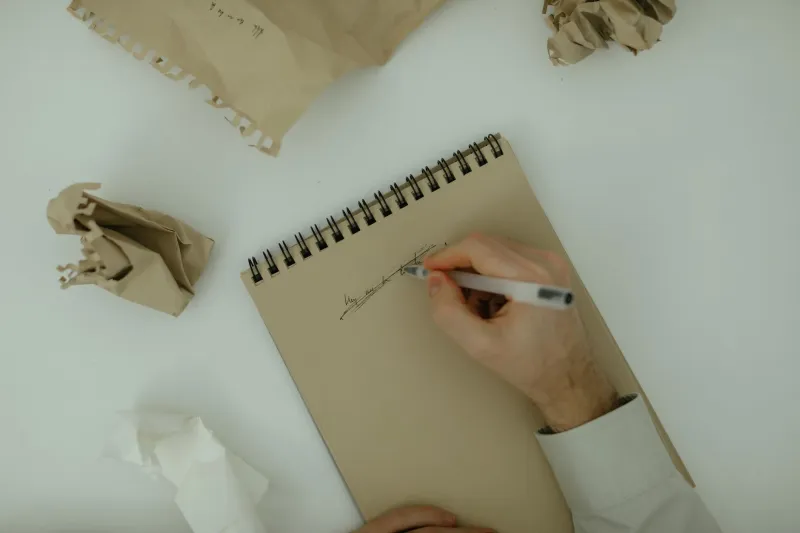
There is a quality of engagement that rough work invites that polished work tends to suppress. When a client sees a sketch — a loose thumbnail, a hand-drawn concept map, a low-resolution layout with placeholder type — they understand implicitly that the work is in motion. The rough state signals that contribution is welcome, that the direction has not been finalized, that their perspective can still meaningfully shape what emerges.
This shifts the client from the role of approver to the role of collaborator. And that shift produces different, more useful conversations.
Design researchers have documented this phenomenon in various contexts, noting that stakeholders presented with obviously incomplete materials tend to engage more critically and more specifically with the underlying concepts — the ones that actually matter — rather than the surface qualities of the execution. The incompleteness functions as an implicit invitation: help us finish this.
In practical terms, this means that a rough sketch of three brand directions will often generate more strategically valuable feedback than three fully rendered logo presentations. The client who might have said "I like option two" in the polished review will, when looking at rough concepts, more likely say "the energy in option two feels right, but I'm not sure it speaks to our enterprise clients" — which is the kind of insight that actually informs creative decision-making.
Reframing the Language
Much of the resistance to showing early work is rooted in a particular professional anxiety: the fear that roughness will be read as incompetence. If a client sees unfinished work, will they conclude that the agency is unfinished? Will they lose confidence in the team's ability to deliver?
This concern is legitimate, but it is manageable — and largely a function of framing. The difference between presenting rough work apologetically and presenting it intentionally is the difference between signaling disorganization and signaling method.
Agencies that share early-stage materials effectively do so with a clear narrative: We are showing you this at this stage because your input will shape what it becomes, and that input is most valuable before the work is set. This positions the rough presentation not as a shortcut but as a deliberate act of strategic inclusion. It communicates respect for the client's intelligence and for the collaborative nature of the work.
At Kirr Concept, this kind of intentional transparency is understood as a component of the creative relationship rather than a concession within it. The studio's process is built on the premise that clients who understand how work develops are better equipped to contribute to its development — and that the quality of the final output is directly related to the quality of the conversation that surrounds it.
The Feedback That Only Roughness Produces
There is a category of client insight that is almost impossible to access through polished presentations. It is the kind of response that emerges when a stakeholder feels free enough to say: I'm not sure this is the right direction at all.
This is the most valuable feedback in a creative engagement. It is also the feedback that a beautifully rendered presentation tends to suppress, because the social dynamics of reviewing finished-looking work make fundamental objections feel rude or disruptive. Clients who might have redirected a project at the concept stage instead approve the direction and raise concerns later — at a point when raising them is genuinely disruptive and expensive.
Rough work lowers that threshold. It makes the fundamental question — is this the right direction? — feel appropriate to ask, because it is obvious that the answer can still change what happens next.
A Different Kind of Confidence
The creative teams that are most effective at presenting early-stage work share a particular quality: they are confident enough in their process to be transparent about it. They understand that showing rough work is not an admission of uncertainty about the outcome — it is an expression of certainty about the method.
This is the paradox at the center of the prototype problem. The agencies that hide their work until it is pristine are often signaling, inadvertently, that their process cannot withstand scrutiny. The agencies that open their process to clients at every stage are demonstrating that the process itself is the value — that the thinking, the iteration, the progressive refinement is precisely what clients are engaging when they work with a serious creative partner.
Showing the seams is not a vulnerability. It is an argument for the quality of the craft that produced them.